PiggyVest SafeLock Review in Nigeria: Interest Rates, Lock Periods, Withdrawal Penalties and Safety
PiggyVest SafeLock gives you a digital fixed-term savings option from ₦1,000, with published rates that rise by tenor and can go as high as 21% p.a. on one FAQ page. The real story is less about the headline rate and more about the lock rules: your money can be genuinely inaccessible, early exit can cost all accrued interest, and PiggyVest’s own public rate claims do not line up perfectly across pages.
PiggyVest SafeLock
Piggytech Global Limited (PiggyVest)
- Category
- Savings
- Minimum Deposit
- ₦1,000
- License
- Licensed
- Regulated By
- SEC
Introduction
If you are looking at PiggyVest SafeLock, you are probably not asking for marketing language. You want the practical answers: how much interest it can actually pay, how long your money will be tied down, what happens if life happens before maturity, and whether the whole thing is genuinely safe enough to trust with your savings. Those are the right questions, because SafeLock is useful only if the lock terms match your real cash-flow life, not your best intentions on a good day.
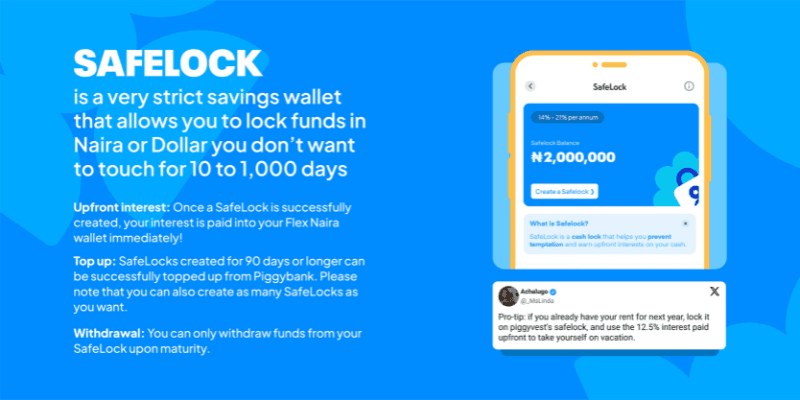
The short answer is that SafeLock is PiggyVest’s fixed savings option. You can lock money for a set period, starting from 10 days, and PiggyVest publishes tiered annual rates that rise with longer tenors. The entry point is unusually low at ₦1,000, which makes it far more accessible than many traditional bank fixed deposits. But that convenience comes with a real tradeoff: this is not the place for emergency money, and the rules on access depend on whether you chose interest upfront or at maturity.
What makes SafeLock different from the old bank-fixed-deposit model is not just that it is digital. It is that you can do it fully in-app, fund it from your Flex Naira wallet or a debit card, create multiple locks, and even top up an existing SafeLock if the duration is above 90 days. At the same time, some important details need a careful read: PiggyVest’s own pages publish different “up to” rates, its public materials say SafeLock is NDIC-insured without naming a specific coverage ceiling, and long-duration locks appear to have extra conditions around interest payout. So the core promise is simple enough — lock money, earn a fixed rate, get it back at maturity — but the fine print matters more here than the headline number.
Key takeaways
Key Takeaways
- SafeLock is a fixed-term savings product inside PiggyVest, with lock periods from 10 to 1,000 days and a minimum of ₦1,000.
- Published rates vary by tenor, with PiggyVest’s FAQ listing 14% p.a. for 10–30 days up to 21% p.a. above 2 years, but PiggyVest’s own other pages also mention up to 19.5% and up to 18.5%. The exact rate is shown before you create the lock.
- Access rules are strict. If you chose upfront interest, the locked funds are only accessible at maturity. If you chose interest at maturity, PiggyVest says the SafeLock can be broken only after 90 days, and breaking it means forfeiting all accrued interest.
- There is no standalone SafeLock setup or monthly maintenance fee listed in the supplied terms, but PiggyVest says product-linked processing fees may exist and may introduce additional fees in future with notice.
- Safety claims need context. PiggyVest says funds are warehoused and managed by PV Capital Limited, which it describes as a SEC-registered Fund/Portfolio Manager, and PiggyVest also says SafeLock is NDIC-insured. The supplied research does not state a specific naira insurance limit for SafeLock.
Why this matters in Nigeria right now
In Nigeria, fixed-term saving is not just about chasing a headline percentage. It is also about discipline, predictability and access. A lot of people want the certainty of a fixed return, but traditional bank fixed deposits can feel like products built for bigger balances and more patience with paperwork than ordinary savers have.
PiggyVest itself frames SafeLock as a consumer-friendly alternative to a bank fixed deposit, and its comparison gives a useful benchmark: Nigerian bank fixed deposits typically come with minimums from ₦50,000 to ₦500,000, standard tenors of 30, 90, 180 or 360 days, and often involve branch visits or paperwork. Against that backdrop, SafeLock’s ₦1,000 minimum and fully digital setup are not small details. They change who can actually use a fixed-term product at all.
That said, lower entry is not the same thing as lower commitment. SafeLock still asks you to give up access for a defined period, and that can be harder in practice than it sounds, especially when your income is uneven or you are using one account for too many jobs at once. So where SafeLock fits in the market is fairly clear: it is best understood as a digitally packaged fixed deposit-style tool with a much lower barrier to entry, not as a flexible everyday savings account.
How SafeLock actually works
What you are opening
PiggyVest describes SafeLock as a fixed savings option and sub-account. You move money into it either from your Flex Naira wallet or from a debit card, choose a duration, and then the funds stay locked until the product rules allow release. PiggyVest says you can create multiple SafeLocks, which is useful if you save toward different dates rather than dumping everything into one maturity.
The lock length starts from 10 days, and PiggyVest’s landing page says the available range is 10 to 1,000 days. The product can also hold fairly large balances: PiggyVest’s FAQ says each SafeLock can hold up to ₦100 million. At the other end of the scale, the minimum amount is ₦1,000, which is one of the biggest reasons the product stands out from the typical bank fixed-deposit format.
There is one more operational detail worth noticing before you commit money: when a SafeLock matures, PiggyVest says the funds are paid into your Flex Naira wallet. In other words, maturity does not mean the money lands directly in your bank account by default according to the supplied research; it first returns to the PiggyVest wallet environment.
Interest rates, tenors and what the percentages really mean
The most detailed rate table in the supplied research comes from PiggyVest’s FAQ. It lists these bands for SafeLock:
| Lock period | Published rate |
|---|---|
| 10–30 days | 14% p.a. |
| 31–60 days | 15% p.a. |
| 61–90 days | 16% p.a. |
| 91–180 days | 17% p.a. |
| 181–270 days | 18% p.a. |
| 271–365 days | 20% p.a. |
| Above 1–2 years | 20.5% p.a. |
| Above 2 years | 21% p.a. |
PiggyVest also says SafeLock interest is prorated for the chosen duration, and that the exact rate is shown before the lock is created. That last point matters because the annual percentage is not the same thing as what lands in naira for a short lock. A 365-day lock is the easiest way to make the math intuitive: if you locked ₦500,000 for a full year at 20% p.a., that works out to ₦100,000 in interest over that year. If you locked the minimum ₦1,000 for a full year at that same 20% p.a., the interest would be just ₦200. So the percentage can look strong while the actual naira outcome stays modest if your balance is small.
For shorter tenors, think of the headline rate as an annual guide, not a monthly promise. The FAQ explicitly says the return is prorated, which means a 10–30 day lock at 14% p.a. does not pay anything close to 14% of your capital in one month. That is normal for fixed-term savings, but it is exactly the kind of detail people miss when they only remember the biggest number from an ad.
The upfront-interest option is attractive, but read the access rule beside it
One feature PiggyVest highlights is that you can choose whether interest is paid upfront or at maturity. On paper, that sounds excellent. If you want the psychological boost of seeing part of your return early, or you want to separate principal from earnings, upfront interest can feel more rewarding than waiting until the end.
But the access consequence is important. PiggyVest’s FAQ says that if you chose upfront interest, the locked funds can only be accessed at maturity. So the trade is simple: you may get the interest earlier, but your principal is then fully stuck until the agreed date. That is fine if you are locking money you genuinely will not need, and a bad idea if you are using SafeLock to store money that still has emergency duties.
There is also a nuance for long locks that you should not ignore. The supplied research says users can choose upfront interest or interest at maturity, but another FAQ note says that for locks above 365 days, funds and interest are paid at maturity. That means very long SafeLocks may not work the same way as shorter ones. If you are creating a lock beyond one year, the safest reading is: do not assume the upfront-interest option will apply in practice until you see the exact in-app terms before confirming.
Breaking a SafeLock early: this is the real penalty, not a side note
SafeLock’s biggest downside is not a visible fee. It is the rigidity of the withdrawal rules. PiggyVest says that if you chose interest at maturity, the SafeLock can be broken only after 90 days of creation, meaning from the 91st day. If you need the money earlier than that, the supplied research does not offer an earlier break route under that option.
PiggyVest also says that if a user breaks a SafeLock before maturity, the user forfeits all accrued interest. That is the penalty you should keep in your head, even though the product is marketed as having no regular transaction charges or monthly fees. For a concrete sense of the cost, imagine a ₦500,000 lock intended to run for 365 days at 20% p.a.: the full-year interest would be ₦100,000. If you end up breaking early under PiggyVest’s stated rule, that earning is what you give up.
This is why SafeLock works best as a commitment tool, not as a backup wallet. The absence of a setup fee is nice, but it does not make the product “cheap” if you repeatedly lock money you later need. The real cost then becomes lost interest and poor cash planning.
Top-ups and multiple locks make the product more usable than a one-shot deposit
PiggyVest says you can create multiple SafeLocks, and that you can top up an existing SafeLock if the duration is above 90 days. That matters because real savings habits are often uneven. Instead of one large lump sum on day one, you may want to add money as income comes in.
The 90-day condition is important, though. If your chosen duration is short, you should not assume you can keep adding money later. This again reinforces the idea that SafeLock is best used when you already know your timeline reasonably well.
Safety: what is confirmed, what needs more caution
On the regulatory structure, the clearest statement in the supplied research is PiggyVest’s own FAQ saying that funds in a PiggyVest account are warehoused and managed by PV Capital Limited - RC No. 1760152, which PiggyVest describes as a duly registered Fund/Portfolio Manager with the Securities and Exchange Commission of Nigeria. That is useful information because it gives you a named entity behind customer-fund management rather than leaving safety as a vague reassurance.
PiggyVest also says, in an August 2026 blog comparison, that SafeLock is NDIC-insured and that the deposit-insurance limit varies by institution tier. But the supplied material does not state a specific naira coverage ceiling for SafeLock itself. So the fairest way to read the safety claim is this: PiggyVest publicly makes the NDIC-insured claim, but based on the research provided here, you are not given the exact coverage amount to rely on for planning.
That does not automatically mean the claim is false; it means the published detail supplied to this review is incomplete. For readers trying to decide whether to place a large sum — and SafeLock permits up to ₦100 million per lock — that missing limit matters. “Insured” is a meaningful word only when you know how much protection actually applies.
One awkward but important issue: PiggyVest’s own rate claims do not line up perfectly
This is the biggest information-quality issue in the supplied material, and it is worth stating plainly. One SafeLock landing page markets the product at “up to 19.5% interest per annum.” PiggyVest’s June 2026 blog post says the current SafeLock rate was “up to 18.5% per annum.” But PiggyVest’s FAQ rate table lists bands going as high as 20.5% p.a. above 1–2 years and 21% p.a. above 2 years.
Those figures cannot all describe the exact same current ceiling in the exact same way. The most practical conclusion is not to choose one page and pretend the others do not exist. It is to treat SafeLock’s in-app pre-confirmation screen as the rate that matters for your own deposit, while recognizing that PiggyVest’s public pages are not perfectly harmonized. That inconsistency does not cancel the product, but it does weaken the usefulness of headline marketing claims. If you are deciding between SafeLock and another fixed-term option, the number to trust is the exact rate shown to you before you create the lock, not the biggest “up to” figure you saw on a blog or landing page.
Pros and cons
Pros
- Minimum SafeLock amount is ₦1,000.
- Lock periods run from 10 to 1,000 days.
- PiggyVest publishes a clear tenor-based rate structure and says the exact rate is shown before creation.
- You can fund from Flex Naira or debit card.
- You can create multiple SafeLocks.
- Existing SafeLocks can be topped up if the duration is above 90 days.
- No standalone SafeLock setup fee or monthly maintenance fee is listed in the supplied terms.
- Onboarding is described as fully digital, with no branch-visit step in the public flow.
Cons
- SafeLock is not for emergency money: access is restricted until maturity, or until the rules allow a break.
- If you chose upfront interest, the locked funds are only accessible at maturity.
- If you chose interest at maturity, PiggyVest says the lock can be broken only after 90 days, and breaking it means forfeiting all accrued interest.
- PiggyVest’s public SafeLock rate claims are inconsistent across pages: 18.5%, 19.5%, and a FAQ table up to 21% all appear in the supplied research.
- PiggyVest says SafeLock is NDIC-insured, but the supplied material does not give a specific naira insurance limit for SafeLock.
- PiggyVest’s terms allow additional fees to be introduced in future with notice.
Who SafeLock is actually for
SafeLock makes the most sense for you if you want a fixed-term discipline tool more than a flexible savings account. It fits a saver who already knows the money is for a future date, can live without touching it for that period, and wants a lower entry point than a typical bank fixed deposit. If your main attraction is that you can start from ₦1,000, that is a legitimate reason to consider it — especially because many bank fixed deposits, by PiggyVest’s own comparison, start much higher.
It is a particularly practical fit if your problem is temptation. The rules are strict enough that SafeLock can help protect money from impulse spending, especially when you create separate locks for separate targets. And if you want a long-duration lock above 90 days, the top-up option adds some flexibility that lump-sum-only products do not always give.
It is a poor fit for you if this money may need to double as your emergency fund, rent buffer or unpredictable business cash. It is also a poor fit if you dislike products whose public rate messaging is not perfectly consistent across pages, or if you need a confirmed insurance ceiling before placing a large amount. In plain terms: good for planned money, bad for fragile money.
Fee breakdown
Here is the plainest fee picture the supplied research supports:
| Item | What the research confirms | What it means for you |
|---|---|---|
| SafeLock setup fee | No standalone setup fee listed | No confirmed charge just to create a SafeLock |
| Monthly maintenance fee | No monthly fee listed in PiggyVest’s Terms of Use | No confirmed recurring account-maintenance charge for SafeLock itself |
| Transaction charges | PiggyVest’s Terms say there are no transaction charges for the service, except processing fees linked to specific products published on the website | The supplied research does not name a separate SafeLock processing fee amount |
| Early withdrawal cost | If you break a SafeLock before maturity, PiggyVest says you forfeit all accrued interest | This is the main practical cost of exiting early |
| Future fees | PiggyVest says it may introduce additional fees in future if users are notified first | “No fee” is true only on the currently supplied terms; it is not a forever guarantee |
So, if you are asking whether SafeLock has the sort of obvious maintenance charges that quietly eat returns, the supplied terms do not show them. But if you are asking whether SafeLock is cost-free in every practical sense, the answer is still no, because breaking early can wipe out the interest you expected to earn.
KYC and onboarding
PiggyVest’s public onboarding flow is described as fully remote. The supplied FAQ says you can visit the website or download the app, create an account, set your withdrawal bank details, enter a debit card to activate the account, make your first deposit, and then start using the savings plans. The public description in the research does not include any branch-visit step.
What PiggyVest says you need or may be asked for in the supplied terms and FAQ:
- Acceptance of the Terms and Privacy Policy.
- Registration on the website/app.
- A Nigerian bank account.
- Basic personal information such as full name, date of birth, email address, phone number, current residential address, bank-account-related details/credentials, and possibly security-question answers.
Identity-verification items PiggyVest says it may require
- A government-issued photo ID such as passport, national identity card, or driver’s licence.
- And/or a selfie with the valid ID.
- BVN.
- NIN.
- A utility bill, bank statement, affidavit, or other bill dated within three months and showing your name and Nigerian street address.
- Any other information or documents requested from time to time.
Two points need careful wording here. First, the supplied research says BVN is required to validate identity and prevent identity theft, and that linking BVN unlocks additional features such as generating a Flex account number in your name for transfers from a banking app. Second, NIN appears in the list of items PiggyVest may request, but the wording in the supplied terms does not say NIN is mandatory for every user in every case.
Eligibility is also clearly limited in the supplied terms: the service operates only in Nigeria, is available only to users with Nigerian bank accounts, and the user must be a Nigerian citizen or legal Nigerian resident who is at least 18 years old. No explicit CBN KYC tier is stated in the supplied research.
Unique feature spotlight
No genuinely category-distinct feature was confirmed strongly enough in the supplied research to justify a separate “standout feature” section without overclaiming. SafeLock does have useful mechanics — especially the ability to choose interest upfront or at maturity, create multiple SafeLocks, and top up locks above 90 days — but the research packet does not establish that these are uniquely unavailable in the main competing products.
Rather than force a flashy claim, it is more accurate to say SafeLock’s appeal comes from the combination of a low ₦1,000 minimum, fixed-term structure, and fully digital access, not from one clearly verified category-exclusive feature.
Where competitors come in
If you are comparing SafeLock with a traditional Nigerian bank fixed deposit, PiggyVest’s own comparison says banks often start at ₦50,000 to ₦500,000 and may involve branch visits or paperwork, while SafeLock starts at ₦1,000 and is handled in-app. That does not automatically make SafeLock better; it makes it more accessible, especially if your main barrier to fixed-term saving is entry size and process friction.
Regulatory note
PiggyVest’s official FAQ says customer funds are warehoused and managed by PV Capital Limited - RC No. 1760152, which PiggyVest describes as a duly registered Fund/Portfolio Manager with the Securities and Exchange Commission of Nigeria. That is the clearest public statement in the supplied research about the regulated structure behind PiggyVest account funds.
PiggyVest also says SafeLock is NDIC-insured, but the supplied material does not provide a SafeLock-specific naira coverage ceiling. So the license and insurance discussion here should be read with the right level of caution: this review is reporting PiggyVest’s own published statements from the supplied research packet, not an external regulator-register check.
For business-history context, PiggyVest says it launched first as Piggybank.ng on January 7, 2016, rebranded to PiggyVest in April 2019, and lists its office address as Tesmot House, 3 Abdulrahman Okene Close, off Ligali Ayorinde Street, Victoria Island, Lagos.
Bottom line
PiggyVest SafeLock is a good fit if what you want is a digital fixed-term savings tool with a very low entry point and you genuinely mean to leave the money alone. The ₦1,000 minimum, 10-day starting tenor, multiple-lock setup and fully remote onboarding make fixed-term saving more reachable than the bank-deposit model many Nigerians are used to. If your biggest problem is self-control rather than access, SafeLock can be genuinely useful.
But it is not a casual savings pocket. The lock rules are strict, the early-exit cost is the loss of accrued interest, and PiggyVest’s own public rate claims are not perfectly consistent. So my verdict is simple: use SafeLock for planned money with a known timeline. If the money might need to rescue you before maturity, or if you need a fully clarified insurance limit and perfectly aligned public pricing before you commit, look elsewhere.
FAQ
Frequently Asked Questions
What is the minimum amount I can put in SafeLock?
What is the maximum I can keep in one SafeLock?
Can I withdraw before maturity?
Do I need BVN or NIN to open a PiggyVest account for SafeLock?
Is SafeLock available if I live outside Nigeria?
What happens when my SafeLock matures?
What to do next
If SafeLock sounds close to what you need, do one careful check before you commit: look at the exact rate and payout terms shown in-app for your chosen tenor, especially if you are locking money for more than a year. Then ask yourself one blunt question: can this money stay untouched for the whole period without creating a problem elsewhere? If the answer is yes, SafeLock can be a practical discipline tool. If the answer is shaky, keep that money in something more accessible.
Sources
- Piggyvest at 10: Inside Piggyvest’s 10th Anniversary Gala(official_site)
- Terms - PiggyVest(official_site)
- FAQs - PiggyVest(official_site)
- Create a Secure Savings Account - PiggyVest(official_site)
- About PiggyVest(official_site)
- What Is A Certificate Of Deposit (CD)?(official_site)
- FAQs - PiggyVest(official_site)
- How Do Piggyvest Interest Rates Work?(official_site)
- Lock funds with Safelock™ - PiggyVest(official_site)